
Ponder
Founding Product Engineer · 2024–2025
A social prediction game on Farcaster where users earned cash rewards by predicting poll outcomes. I was the only frontend engineer on a four-person founding team. We went from idea to 35,000 users in 18 months.
My role: Everything the user touched. UI architecture, interaction design, visual design, frontend implementation. No design team, no Figma handoffs — I designed in code and shaped the product alongside the founders.
Native feel, web stack
Ponder lived inside Farcaster's mobile app as a web view. It had to feel like a native app. I built it around iOS interaction patterns — CSS scroll snap navigation, spring animations tuned per-transition, anchored bottom nav, fullscreen and contextual modals. Mobile-first from day one, not retrofitted responsive.
Invisible web3
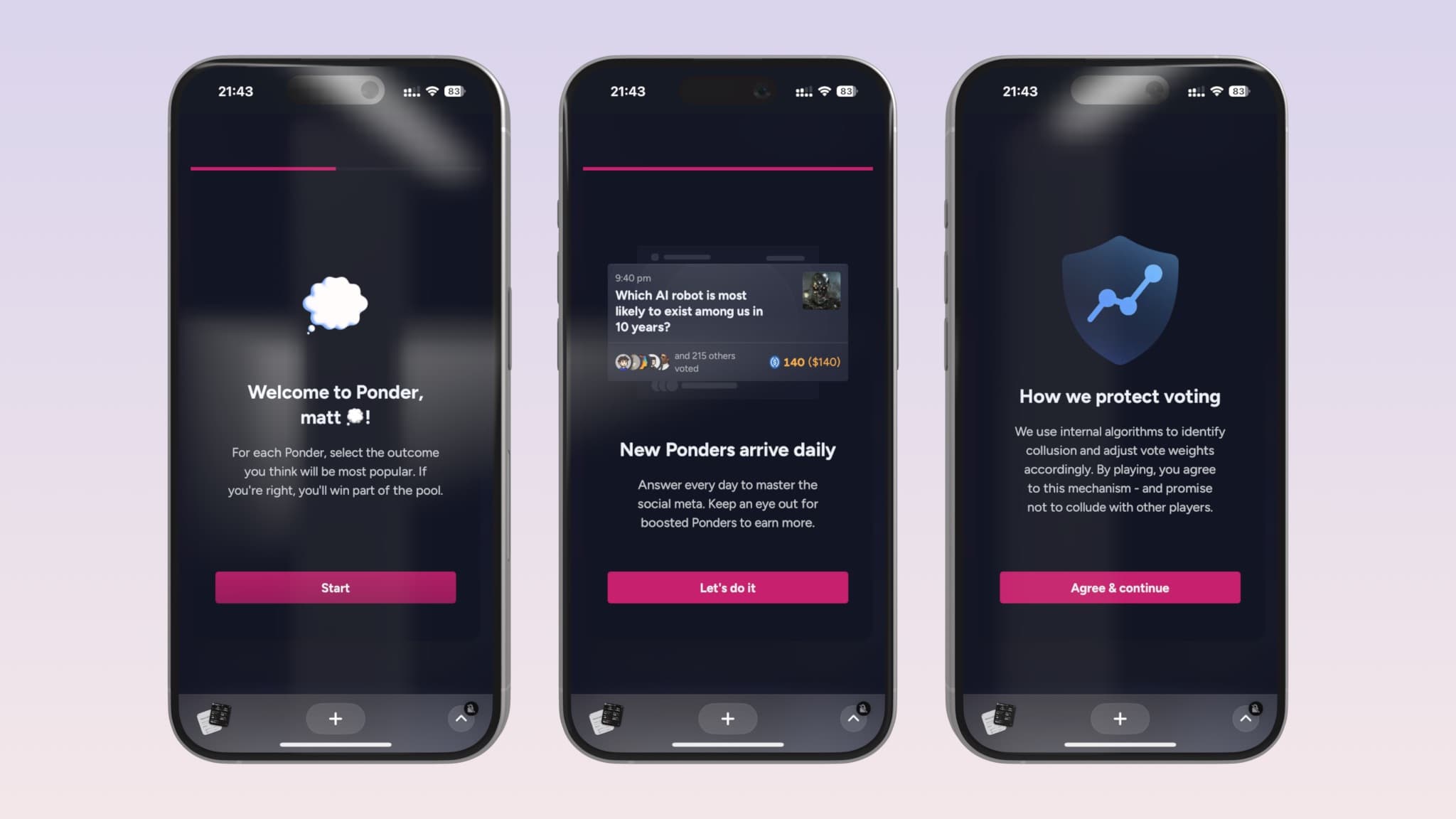
Onboarding took under 30 seconds. Users never saw the word "wallet." While they read a welcome screen, the app silently authenticated via Farcaster, pulled profile data through Privy, and provisioned an embedded wallet via thirdweb. By the time they finished viewing onboarding screens, their account was live and funded. 95%+ completion rate.
Feels instant, no WebSockets
Users expected real-time feedback on predictions and leaderboards. Instead of adding WebSocket infrastructure, I built selective cache invalidation with Next.js server actions, ISR, and API route cache busting — only stale data refetches. Motion.dev animated containers masked latency. The result felt live on a simple, cheap, maintainable architecture.
Craft that builds trust
In web3, most products look like they were built in a weekend. Design quality is a trust signal when you're asking users to put money in. I designed streak mechanics, free-to-play predictions, creator incentives, and threaded comments to drive daily engagement. Over 60% of lurkers converted to regular participants. Ponder held #1 on Farcaster's app charts for weeks on ~$10k total marketing spend.